Following the success of its inaugural UK edition in 2025, MDOTM brought the Future Intelligence Forum to the United States for the first time. Hosted at Troutbeck in New York's Hudson Valley, the event welcomed nearly 40 senior executives from some of the world's leading financial institutions, including Morgan Stanley, Invesco, Bank of America, Pictet Asset Management, Franklin Templeton, Vanguard, Northern Trust, PGIM, Harbor Capital Advisors, Unipol and others, Over two days, participants came together to explore one of the defining questions facing our industry: what role will human judgment play as artificial intelligence becomes increasingly capable?

Unlike a traditional industry conference, the Forum was designed as an opportunity for deep discussion across disciplines. By bringing together perspectives from neuroscience, artificial intelligence, leadership and investment management, the event examined how intelligent systems are reshaping decision-making, and why the future of investing will depend on combining technological progress with uniquely human capabilities.
The Science of Human Judgment
The Forum opened with Dr. Heather Collins, Cognitive Neuroscientist and Brain Scientist, whose keynote, The Science of Judgment: How Humans & Machines Make Decisions, laid the scientific foundation for the discussions that followed. Drawing on neuroscience, cognitive psychology and behavioral science, she challenged one of the most common assumptions about intelligence: the human brain is not primarily a thinking machine, but a prediction machine. Rather than simply reacting to the world, our brains continuously anticipate what will happen next, comparing incoming information against internal models built through years of experience. When those predictions are correct, thinking feels effortless. When they fail, the brain is forced to slow down, reassess and update its understanding of reality, a process that, while cognitively demanding, is fundamental to learning, adaptation and the development of expertise.
Through a series of interactive experiments with the audience, Heather illustrated how easily our brains fall into cognitive shortcuts. One of her central insights was the concept of fluency bias: when information is delivered quickly, clearly and confidently, our brains instinctively perceive it as more trustworthy, even when it may not be correct. This, she argued, is one of the greatest challenges posed by generative AI. Because AI produces fluent, immediate and highly convincing answers, it can create an illusion of certainty that discourages critical thinking unless users consciously engage their own judgment.
Rather than framing AI as either a threat or a replacement for human expertise, Heather proposed a different model: AI should become a collaborative thinking partner, not a substitute for thought itself. She introduced a framework designed to keep humans cognitively engaged throughout the decision-making process, encouraging people to formulate their own ideas first, use AI to challenge and refine their reasoning, and continuously calibrate their confidence instead of accepting answers at face value. In her view, the goal is not to think less because AI exists, but to think better with AI.
Her closing message set the tone for the entire Forum. As access to information becomes universal and AI systems continue to grow more capable, sustainable competitive advantage will no longer come from possessing more information, but from transforming information into knowledge—and ultimately into sound judgment. The future, she argued, belongs to those who use AI to strengthen curiosity, critical thinking and human expertise, rather than allowing it to replace them.

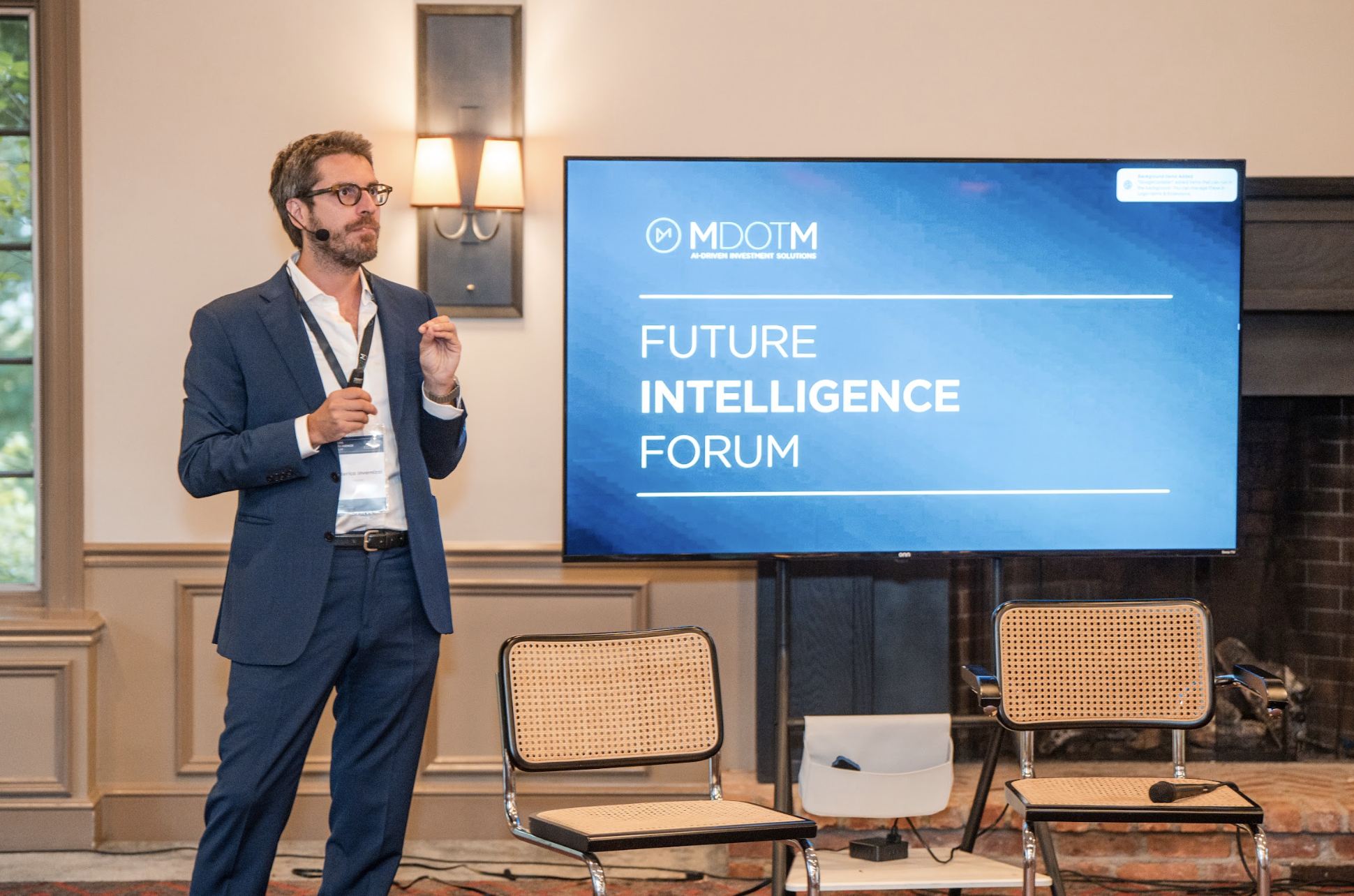
The discussion then shifted from the science of decision-making to the future of the investment industry. Federico Invernizzi, COO & Board Member at MDOTM, explored how AI agents are set to fundamentally reshape asset and wealth management—not simply by automating tasks, but by redefining how firms deliver investment services at scale. Drawing on insights from more than 200 conversations with global asset and wealth managers, he argued that the industry is reaching an inflection point driven by three structural shifts: the transition from institutional to retail investors, the emergence of a broader and more diverse client base, and rapidly rising expectations for personalized investment experiences. Together, these trends are creating an exponential increase in complexity that traditional operating models can no longer absorb.
AI agents, he explained, finally make large-scale personalization economically viable. Tasks that were once prohibitively expensive, from customized portfolio construction and tailored reporting to always-on investment insights and hybrid advisory, can now be delivered to far larger client populations. However, Federico emphasized that simply adopting AI agents will not create competitive advantage. The firms that succeed will be those that redesign their operating models around them, using AI to amplify human expertise rather than replicate existing workflows.
A central theme of his presentation was that there are fundamentally different ways to build AI-native organizations. He contrasted a "bottom-up" approach, where powerful language models repeatedly interpret unstructured information at every step of a workflow, with a "top-down" architecture that begins by structuring business knowledge once and then reusing it consistently across every process. The former, he argued, leads to rising costs, inconsistent outputs and poor scalability; the latter creates reliable, reusable intelligence that compounds over time, allowing organizations to scale AI sustainably while keeping humans firmly in control of high-value decisions.
His closing message was clear: scale is no longer the competitive moat it once was. As AI lowers the barriers to execution, the advantage will increasingly belong to firms with the cleanest data, the clearest strategic priorities and the discipline to define where human expertise creates the greatest value. Those who move decisively today, he concluded, have a unique opportunity to reshape their organizations before the rest of the industry catches up.
These ideas were then brought into the perspective of some of the world's leading investment institutions during The Investor's Edge: Human Judgment in the AI Era. Moderated by Christina Viglietta, VP of Americas at MDOTM, the panel brought together senior investment leaders from Morgan Stanley, Invesco and Bank of America to discuss how AI is already reshaping investment decision-making across the industry. Rather than debating whether AI will become part of the investment process, the discussion focused on a more practical question: where does AI genuinely create value, and where does human judgment remain irreplaceable?
Across the conversation, panelists described AI as a powerful force multiplier rather than an autonomous decision-maker. They shared how intelligent systems are already improving investment research, portfolio engineering, idea generation, personalization and client communication, enabling investment teams to operate with greater speed, consistency and scale. Yet they also emphasized that the most important investment decisions continue to depend on qualities that AI cannot fully replicate: contextual understanding, experience, accountability and the ability to navigate uncertainty when there is no objectively correct answer.
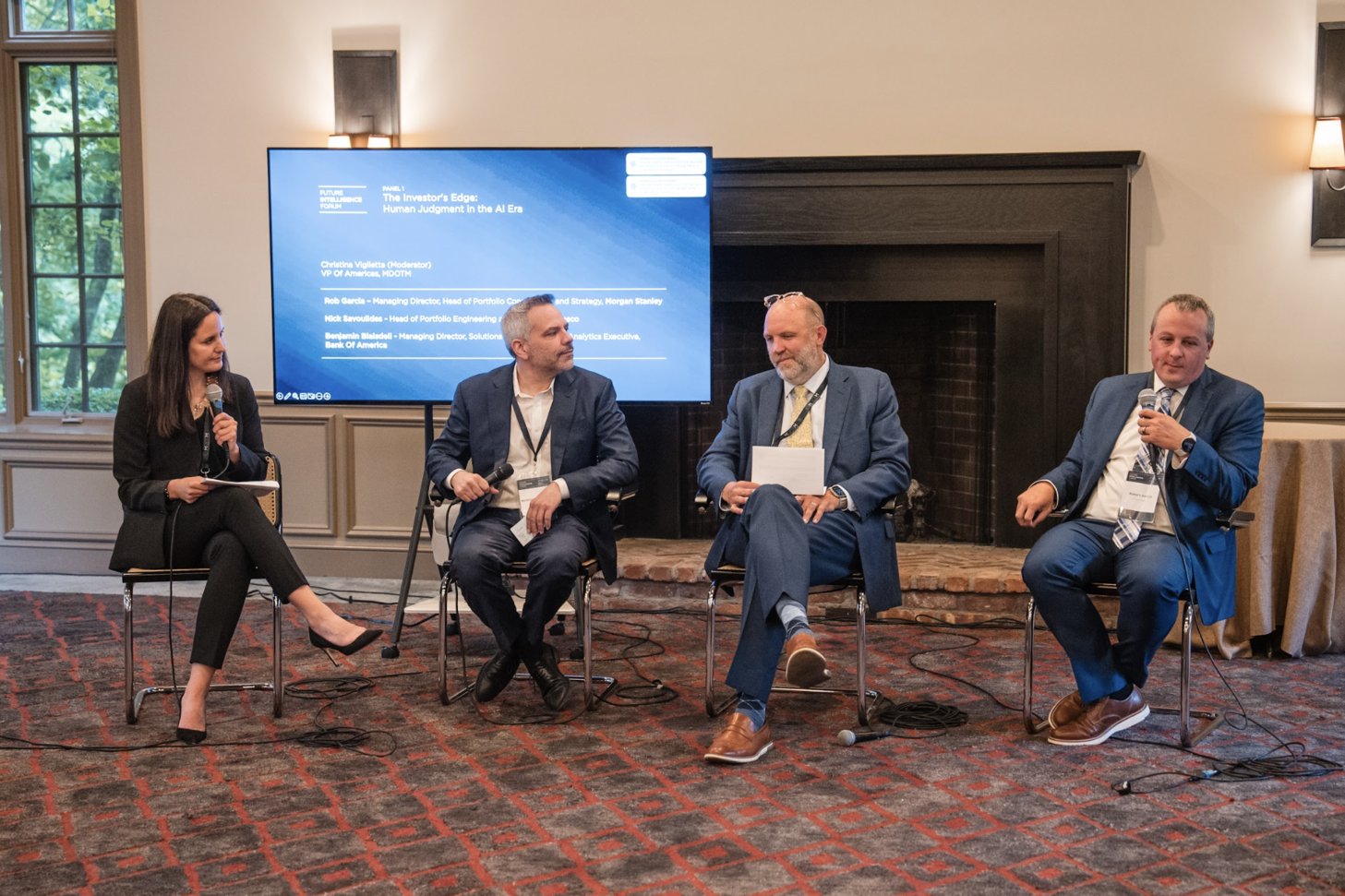
A recurring theme was that the future of investment management will not be defined by automation, but by augmentation. As AI becomes embedded throughout the investment lifecycle, firms must deliberately design workflows that combine the analytical power of machines with the judgment of experienced professionals. Rather than asking whether humans or AI should make decisions, the discussion explored how responsibility should be shared between the two, ensuring that technology enhances decision quality while preserving trust, oversight and clear ownership.
Looking ahead, the panel agreed that the industry's next generation of leaders will not necessarily be those with access to the most advanced AI, but those that most effectively integrate intelligent systems into their investment process while maintaining a clear understanding of which decisions should always remain human.
Understanding the Technology Behind AI
Federico Mazzorin, Chief Scientist & Co-Founder of MDOTM, opened the technology sessions with LLMs and Learning a Model: From language prediction to capturing dynamics. His presentation provided a practical look at the foundations of modern AI, helping attendees separate technological reality from market hype and understand how these systems are beginning to reshape investment organizations. Federico's presentation drew a fundamental distinction between large language models, which predict the statistically likely next word based on patterns in text, and "learning a model," which means capturing the actual dynamics that govern a system, the difference between AlphaFold predicting protein shapes or AI forecasting weather versus ChatGPT completing a sentence. He explaines why LLMs excel at math and code (answers can be verified) but can't make genuine scientific leaps, since they interpolate within what they've already seen rather than stepping outside it. The talk then turned naturally into to finance, showing why markets resist the same treatment as proteins or weather: they're an open system shaped by unpredictable outside events, they're reflexive (a model's use changes the very dynamic it's trying to predict), and the real signal is buried in overwhelming noise. The proposed solution isn't one giant model trying to capture "the market," but many small, specialized, continuously retrained models, each mastering a narrow, verifiable slice (regime, risk, correlation), that combine into a more robust and resilient system than any single monolithic model could be.
We then closed the morning sessions with Professor Hod Lipson, Director of Columbia University's Creative Machines Lab, who delivered The Limits of Intelligence & Robotics: Why the Future Will Not Look Like the Headlines. Rather than focusing only on recent breakthroughs, he challenged common misconceptions surrounding AI, explaining both its extraordinary capabilities and its fundamental limitations, particularly in interacting with and understanding the physical world.

Building AI-Native Investment Organizations
The afternoon shifted from technology to organizational transformation. During Building the AI-Native Investment Organization, experts in organizational design, consulting and technology from Evolution, Capco and Dispatch Integration discussed how firms can successfully integrate AI into everyday decision-making. One of the panel's central conclusions was that AI transformation is fundamentally a people transformation, not a technology transformation. The discussion challenged the idea that competitive advantage comes simply from deploying AI tools, arguing instead that lasting success depends on redesigning organizations around them. Panelists emphasized that leadership, governance, workforce reskilling and change management will become as important as the technology itself, while the most valuable human skills will increasingly be judgment, adaptability and the ability to work effectively alongside AI agents.
Becoming AI-native requires fundamentally rethinking how people and intelligent systems collaborate to create lasting competitive advantage.
.png)
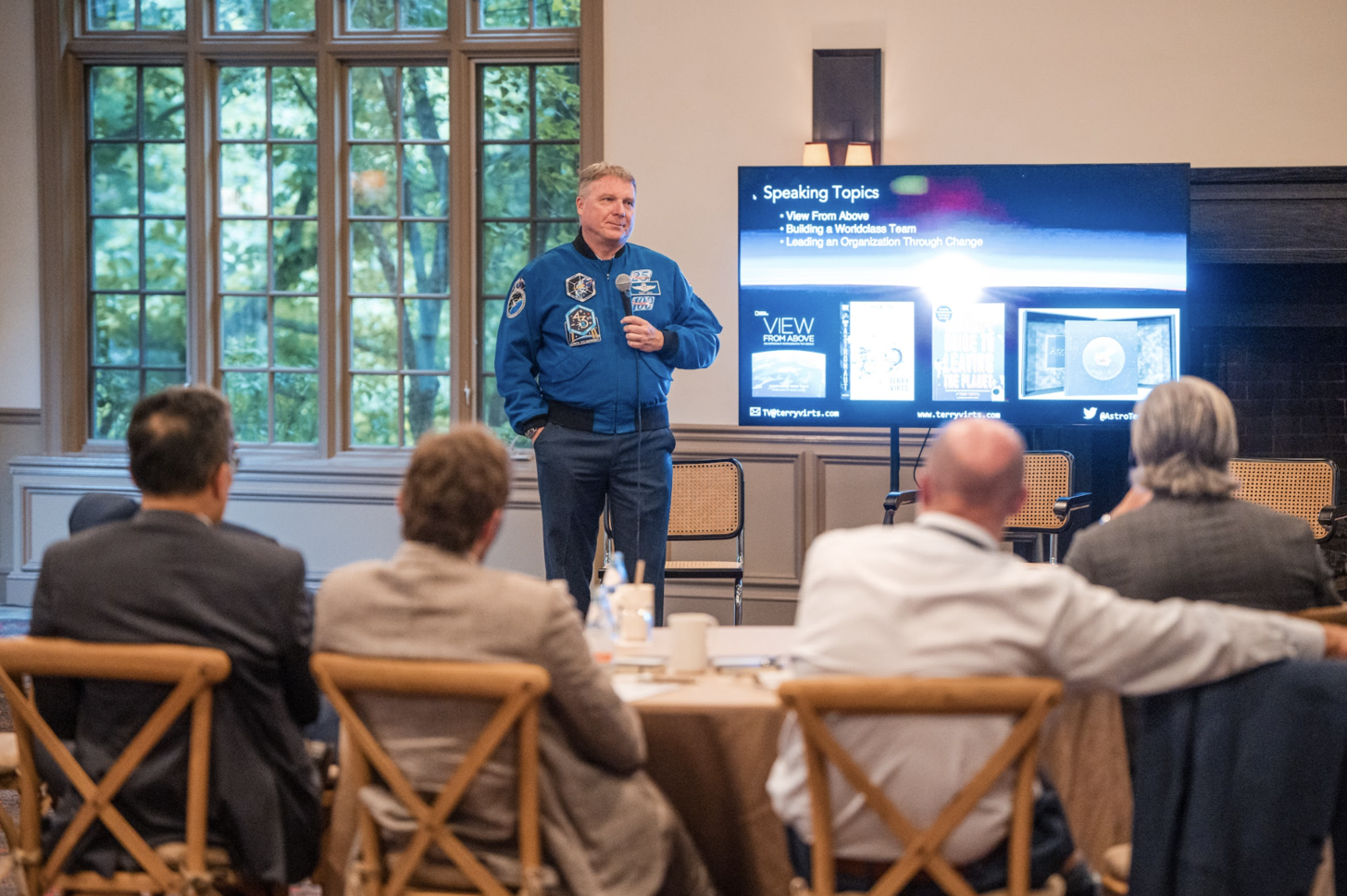
The Forum concluded with a captivating keynote by former NASA astronaut Terry Virts, who shared the extraordinary journey that took him from military pilot to spending more than six months aboard the International Space Station. Through personal stories—from the intensity of his first rocket launch to the realities of living and working in space, Virts offered the audience a rare glimpse into one of the most demanding environments humans have ever experienced.
Beyond the remarkable anecdotes, his presentation became a powerful reflection on leadership under pressure. Whether preparing for years for a mission, making critical decisions in high-stakes situations or leading teams operating thousands of miles from Earth, Virts emphasized the importance of preparation, discipline, trust and clear communication. Success, he explained, is rarely the result of individual brilliance alone, but of teams that train relentlessly, rely on one another and remain calm when facing the unexpected.
Bringing the Forum to a close, his keynote offered a fitting reminder that while technology continues to expand what is possible, the qualities that ultimately define exceptional performance—leadership, resilience, teamwork and sound judgment—remain fundamentally human.
Beyond the keynote sessions, attendees also took part in a private clay pigeon shooting experience, creating space for informal conversations and meaningful networking in the unique setting of the Hudson Valley.
Leadership Through Live Music
The Forum closed with an interactive leadership session led by Jeri Johnson and a live chamber orchestra. Rather than presenting a traditional concert, Jeri invited a volunteer from the audience with no conducting experience to lead the musicians. Despite the orchestra's exceptional talent, the performance quickly lost its cohesion, demonstrating how even highly skilled individuals struggle without effective leadership. When Jeri resumed the podium, the same musicians immediately came together as a unified ensemble, illustrating how trust, communication and shared purpose transform individual excellence into collective performance.

Human Judgment Matters More Than Ever
Across every keynote, panel discussion and conversation, one message consistently emerged: artificial intelligence will undoubtedly transform the investment industry, but its greatest impact will not come from replacing people. It will come from enabling them to make better decisions.
The organizations that will lead the next generation of asset and wealth management will be those that successfully combine technological innovation with human expertise, critical thinking and leadership.
Human judgment becomes more valuable, not less, as AI capabilities increase.


.jpg)


%20(2).png)