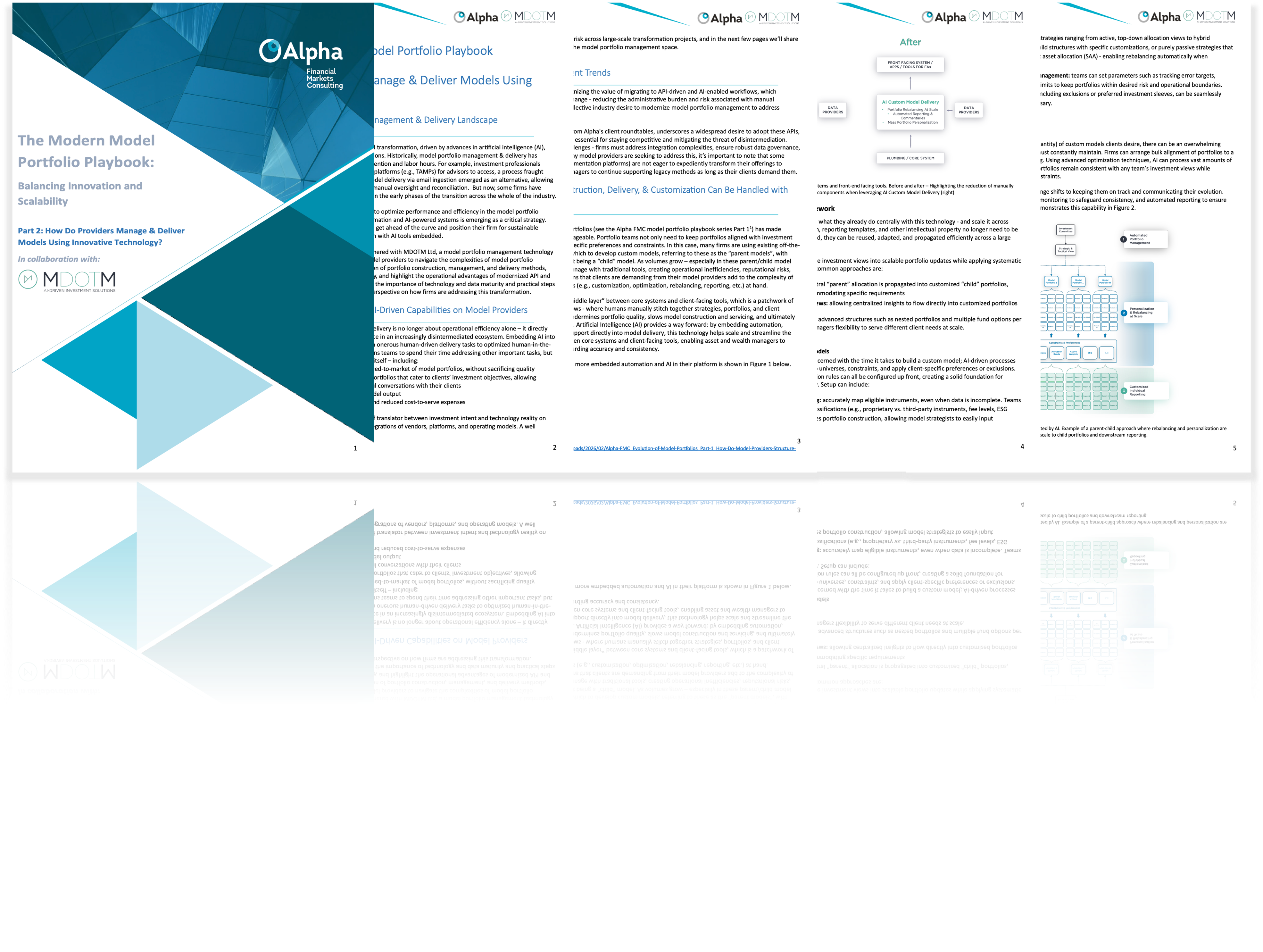
Model portfolio management is undergoing a structural transformation. What was once a manual, operations-heavy discipline is becoming a technology-enabled, intelligence-driven capability.
How AI and APIs Are Transforming Model Delivery
Model portfolio management is undergoing a structural transformation. What was once a manual, operations-heavy discipline is becoming a technology-enabled, intelligence-driven capability. As outlined in The Modern Model Portfolio Playbook developed by Alpha FMC in collaboration with MDOTM, the way model providers construct, manage, and distribute portfolios is being fundamentally redefined.
This is not incremental improvement. It is a shift in operating model and competitive positioning.
From Manual Execution to Intelligent Infrastructure
For years, model delivery relied on spreadsheets, email ingestion, and manual uploads into partner platforms. Investment professionals entered weights, reconciled discrepancies, and monitored alignment through fragmented workflows. These processes consumed resources, introduced operational risk, and limited scalability.
Today, firms are migrating toward API-first architectures and AI-enabled workflows. Real-time integration reduces reliance on manual file transfers. Automation minimizes reconciliation errors. Most importantly, investment teams can redirect their attention from administrative execution to strategic decision-making.
Model delivery is no longer a back-office task. It is becoming a strategic lever for growth, differentiation, and operational resilience.

Customization at Scale: The Parent–Child Model Framework
The rise of custom model portfolios has dramatically increased complexity. Advisors expect portfolios tailored to client-specific constraints, preferences, and regulatory considerations. As the number of variations expands, traditional tools struggle to keep pace.
A scalable solution is the parent–child architecture. A central “parent” model expresses the core investment view. From that foundation, multiple “child” portfolios inherit the strategic allocation while incorporating individualized adjustments.
Artificial intelligence enables this structure to function at scale. Investment views can be translated into systematic portfolio updates that propagate across thousands of accounts while respecting tracking error limits, allocation bands, turnover thresholds, and exclusion rules. Instead of manually rebuilding portfolios, firms can apply centralized intelligence consistently and efficiently.
The result is a balance between personalization and control.
Embedding AI Across the Portfolio Lifecycle
AI enhances model delivery at every stage of the lifecycle.
During setup, systems can map investable universes even when data is incomplete. Instruments can be tagged by characteristics such as fee levels, ESG alignment, or proprietary status. Benchmarks, risk targets, and allocation rules are configured upfront, establishing a structured foundation for scalable management.
In ongoing management, advanced optimization tools allow bulk alignment of portfolios to centralized market views. Thousands of portfolios can be updated simultaneously while preserving client-specific constraints. Continuous monitoring provides alerts when portfolios approach risk boundaries or drift from investment intent.
This shifts oversight from reactive to proactive.
Monitoring, Oversight, and Governance
AI-powered monitoring provides transparency at both the portfolio and aggregate levels. At the individual portfolio level, managers gain detailed insight into volatility, risk exposures, and performance evolution. At the aggregate level, firms can detect systemic risks, underperforming models, or structural imbalances across the full model suite.
Importantly, AI augments governance rather than replacing it. Investment committees retain oversight while benefiting from automated controls and structured constraint enforcement.
Operational risk decreases. Governance strengthens.
Reinventing Reporting Through Controlled Generative AI
Model providers are responsible not only for portfolio construction but also for explaining portfolio positioning. Historically, commentary and reporting required significant manual effort.
Controlled generative AI transforms this process. Narrative explanations of allocation changes, investment rationale, and portfolio evolution can be generated systematically while remaining auditable and aligned with governance standards.
Reports can be tailored to advisors, institutional stakeholders, or end clients without compromising consistency. Communication becomes scalable, timely, and aligned with investment intent.
APIs: The Backbone of Modern Distribution
AI enhances intelligence within the portfolio process, but APIs enable distribution across the ecosystem. Seamless connectivity with intermediaries and execution platforms ensures portfolio updates are transmitted securely and in real time.
This eliminates dependency on manual uploads and email ingestion, both of which introduce delay and error. Even where legacy systems remain in place, structured batch data flows or adapted pipelines can support integration without disrupting existing architectures.
Connectivity is not a technical enhancement. It is foundational to scale.
Technology and Data Maturity as a Prerequisite
Advanced model delivery capabilities require high-quality, well-governed data. Firms with mature technology infrastructures are better positioned to integrate APIs, automate workflows, and leverage AI effectively.
A pragmatic approach is essential. Firms should begin with focused use cases—such as reporting automation or compliance monitoring—before expanding AI integration across broader portfolio processes. This structured path manages risk while building internal expertise.
AI transformation is not achieved through isolated tools. It requires coordinated evolution across data governance, operating models, and architecture.
A New Competitive Baseline
The modernization of model portfolio delivery represents a turning point for asset and wealth managers. The benefits extend beyond operational efficiency. Firms gain scalability, stronger governance, faster rebalancing cycles, improved advisor experience, and enhanced communication quality.
Platforms such as Sphere demonstrate how optimization, monitoring, API connectivity, and generative reporting can be unified within a single framework.
Model delivery has moved from operational necessity to strategic engine.
Firms that embed AI-driven and API-enabled infrastructure today will define the competitive standard of tomorrow’s model portfolio marketplace.
Download The Paper
Download the paper in collaboration with Alpha FMC to learn how AI and API-driven infrastructure are transforming how model portfolios are built, customized, monitored, and delivered at scale.